
What the 2026 “Dear Colleague” Letter on educational technology means for schools
53,000+ Students complete our Kickoff Questionnaire each year, grades 3 through 12 | 1M+ Student responses captured through #WinAtSocial Lessons | +9 pts Growth in students speaking up at one partner school |
The U.S. Department of Education’s August 2026 Dear Colleague letter shifts the ed tech conversation away from counting minutes and toward measuring learning. Assistant Secretary Kirsten Baesler asked schools to make technology use purposeful, instructionally sound, and tied to measurable student outcomes. School leaders can act on that by sorting every tool into one of four tiers of quality use, then bringing real student data to the next technology decision.
What does the Dear Colleague letter say?
It separates recreational technology from instructional tools that deliver measurable value. Baesler wrote that the debate “should not be framed as a choice between technology and no technology.” She asked schools to make technology use “purposeful, instructionally sound, and contributing to measurable student outcomes,” and she left the decisions to districts, working with teachers and families.
Why does federal guidance on screen time feel contradictory?
Two federal messages point in opposite directions. The Surgeon General’s office has recommended that schools limit student screen time and scrap 1-to-1 device programs in favor of computer labs. A White House executive order calls for an infusion of AI throughout K-12 education, including training teachers to integrate it. Baesler’s letter offers a third path and challenges educators to measure learning instead of minutes.
“Measure learning instead of minutes.”
How do schools tell quality tech use from low-quality tech use?
Not all educational tech use is created equal. A 20-minute video to fill the end of class is much different than a 15-minute peer-to-peer discussion about a 5-minute video on AI’s impact on students’ focus.
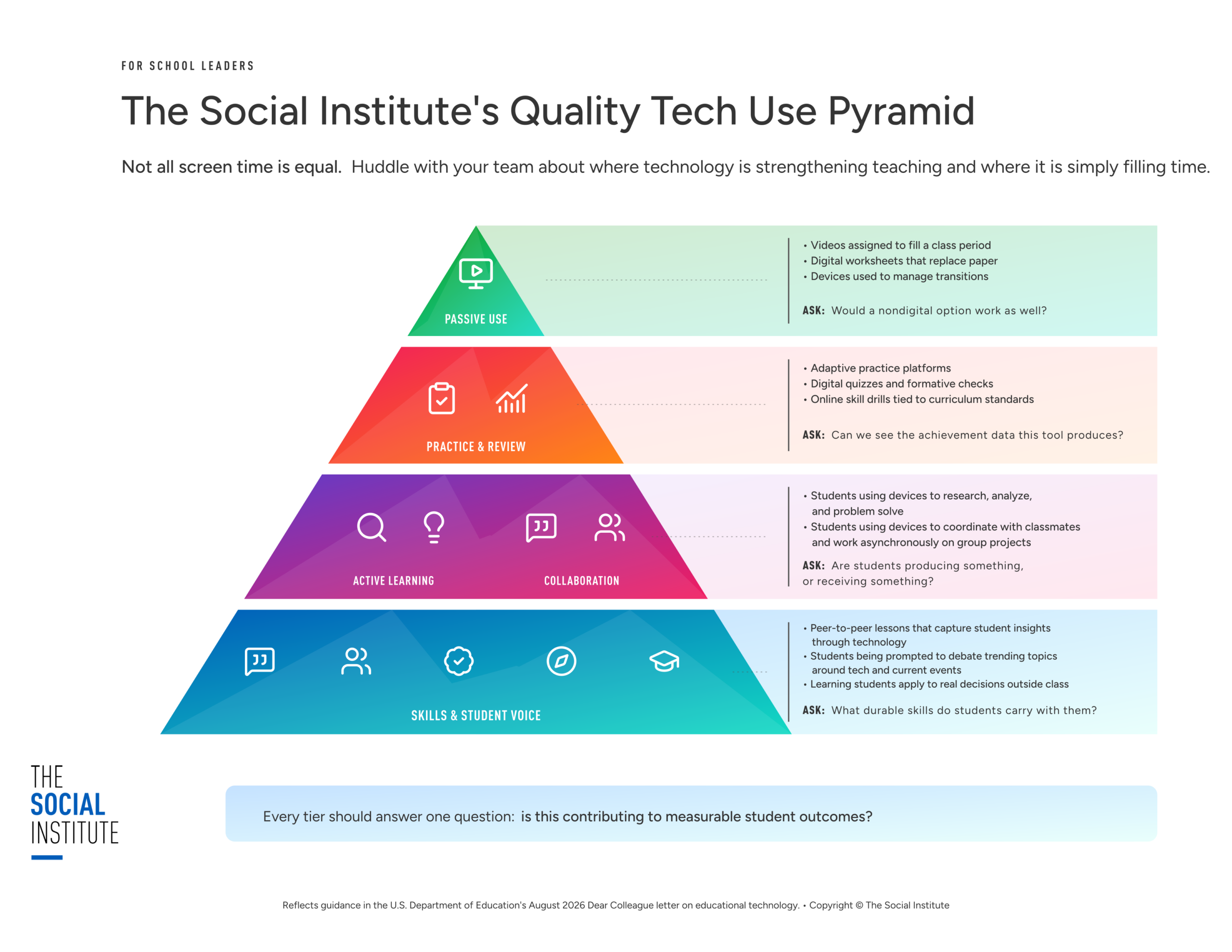
As you consider your ed tech tools, sort each one into four tiers. We call this the Quality Tech Use Pyramid, and it moves from the least valuable use to the most.
|
| ||||
|
| ||||
How do schools measure whether technology improves outcomes?
Measuring outcomes starts with a baseline. Rather than run a separate survey or audit, #WinAtSocial Insights captures student perspective inside lessons that can be run online or offline, so schools get a diagnostic baseline at the start of the year, formative trends as lessons run, and summative results against that baseline at the end of the year.
More than 53,000 students complete our Kickoff Questionnaire each year in grades 3 through 12, and we have captured more than 1,000,000 student responses through #WinAtSocial Lessons. Schools read their own numbers next to national context.
Bowling Green Junior High School is one partner that has watched that movement happen. Belonging climbed 7 points. Students speaking up climbed 9 points. Reported online bullying experiences improved 6 points.
Baesler asked districts to bring exactly this kind of evidence to their next technology decision.
“Every tier should answer one question: is this contributing to measurable student outcomes?”
Frequently asked questions
What is a Dear Colleague letter, and does this one carry legal force?
A Dear Colleague letter is guidance the U.S. Department of Education sends to schools and districts. This one carries no legal force. Baesler noted that decisions about digital tools are best made locally, with input from teachers and families, so districts keep full authority over their own technology policy.
What is outcomes-based contracting for schools?
Outcomes-based contracting ties part of a vendor’s payment to results the tool actually produces for students. The Dear Colleague letter encourages districts to consider it. For school leaders, that raises the value of any platform that can show measurable movement in student data, and it makes efficacy evidence a procurement question rather than an afterthought.
Does the letter mean schools should stop limiting screen time?
No. The letter asks schools to stop treating minutes as the only measure. A district can keep whatever screen time policy it has chosen and still evaluate each tool on what students learn. The Quality Tech Use Pyramid works alongside any device policy, from one-to-one programs to fully tech-free classrooms.
What is the Quality Tech Use Pyramid?
It is a four-tier framework from The Social Institute that helps school leaders sort classroom technology by instructional value: passive use, practice and review, active learning and collaboration, and skills and student voice. Each tier comes with one evaluation question, so a leadership team can audit an ed tech stack in a single meeting.
How can a district show measurable student outcomes to its board?
Start with a baseline, track movement during the year, and compare against a national benchmark. #WinAtSocial Insights captures student perspective inside lessons rather than through a separate survey, producing diagnostic, formative, and summative data that leaders can bring straight into a board meeting.
Want to see what your students would tell you? Learn how #WinAtSocial helps schools measure student well-being and school culture outcomes, and bring real evidence to your next technology decision.
|